
- Leadership That Feels Like You
- Because we are all leaders—and it’s time to lead your way, with joyful purpose.
“Joy is oxygen.”
“Democracy lives in people.”
“The way we lead is the work.”
Those lines sit on a bright-yellow sticky note above Cristina’s desk. Mine says simply: “Sphere of Influence.” They’re daily reminders that democracy is not only an institution we inherit or defend. It is also a culture we practice together, conversation by conversation, decision by decision, breath by breath.
Here is the sentence we want you to remember: Joyful democracy is the practice of building cultures where people can contribute without disappearing.
By democracy, we don’t mean only elections or formal governance, though those matter deeply. We mean the everyday conditions that make shared life possible: whether people feel safe enough to speak honestly, whether leadership makes room for humanity, whether participation requires self-erasure. We mean the cultures we build at work, in community, and in daily life. Everything that follows is an invitation to practice.
We’re often taught to think of democracy as machinery: ballots, budgets, laws, institutions. Those are essential. But the vital signs of a democracy appear much closer to the skin:
Those human questions rarely trend on social media, yet they decide whether a community grows generous or brittle. They also decide whether people show up again.
This is a heavy season for many of us.
Inflammatory rhetoric floods every feed. Hard-won rights contract. Climate alarms blare. Wars destroy. Authoritarian currents strengthen. Inequality widens each quarter. Algorithms, hungry for engagement, weaponize our attention and keep the cortisol humming.
But there’s something else happening too, something less visible. Many of us are living in a state of constant bracing. We scroll through crisis, absorb outrage, try to discern what demands action and what is simply demanding our attention. That kind of sustained vigilance changes how we lead. It narrows our listening and shortens our patience. It can make urgency feel more trustworthy than wisdom.
In that landscape, cynicism feels reasonable, even responsible. But cynicism is expensive: it costs imagination.
Sara (a composite drawn from several clients) runs a five-person nonprofit. On any given Tuesday she is lobbying for a policy amendment, racing to finish a grant proposal, troubleshooting a community partnership, fielding staff Slack pings, parenting a pre-teen, and caring for an ailing spouse. The organization’s mission shines bright. Sara, meanwhile, was clenching her jaw through emails and waking at 3:00 a.m. already negotiating the day. “Spiritually tired,” she called it.
Here’s what matters: her exhaustion wasn’t a personal failure. It was a signal that the culture—even one built on meaningful work—was asking too much of her humanity.
In coaching, we asked her to do something simple but powerful. First, we had her spend ten quiet minutes reconnecting with the nonprofit’s actual mission: not the to-do list, but the why underneath it all. This grounded her.
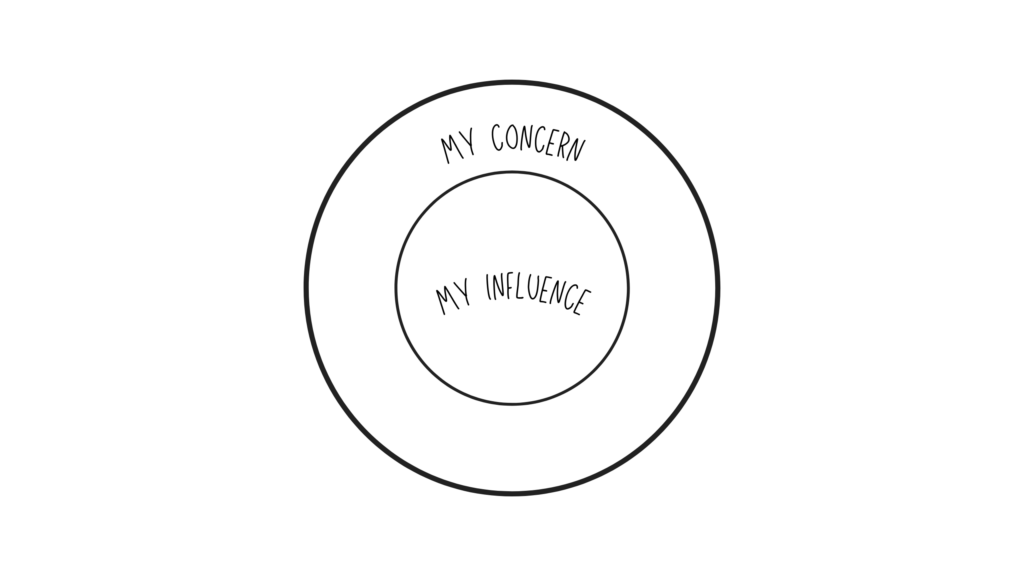
Then we introduced her to a tool we use often: two circles, one labeled “Concern” and one labeled “Influence.”
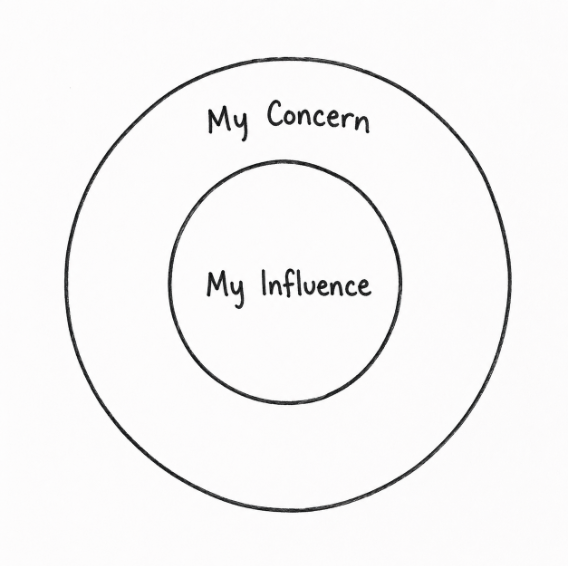
In the outer circle (Concern), she listed everything weighing on her: the mission itself, systemic problems, her team’s burnout, her family’s needs, the state of the world. The full weight of what she cared about.
In the inner circle (Influence), she listed only what she could actually control or directly affect: her own choices, one conversation she could have, one boundary she could set that day.
Then she shaded only the inner circle.
The act of drawing a line around what was actually hers to carry started shifting something important. She could see that the outer circle still mattered, but it wasn’t all her job to solve alone. The weight lifted enough to create a little breathing space.
From there, small experiments became possible. She scheduled one ten-minute walk during office hours. She delegated a routine report. She ended her day once a week at 5:00 p.m. flat.
Small experiments. Real oxygen.
Over time, Sara noticed something shift. The overwhelm lightened. Her capacity grew. But more importantly, she began showing up differently: more present with her team, more willing to delegate, more able to imagine solutions instead of just react to problems. Her experiments became contagious. Others started protecting their own time. The culture began to change.
This matters for democracy: when leaders recover their own presence, they model a way of being that ripples outward. When people aren’t burnt out, they self-silence less. When participation doesn’t require self-abandonment, more voices enter the room.
Joy is not forced positivity, nor an escape hatch from grief, rage, or fear. We know joy can sound frivolous in a time of real danger and loss. We don’t mean optimism detached from reality. We mean the kind of aliveness that helps people stay present to what is true without being consumed (and paralyzed) by it.
Joy does four democratic jobs:
Joy, then, is not dessert we earn after the struggle. It is part of what nourishes our ability to stay in it. It is the difference between showing up and staying gone.
Too many leaders are rewarded for over-functioning and treated as valuable only for what they can produce. The results are predictable:
Exhausted leaders struggle to imagine.
Disconnected leaders struggle to collaborate.
Unseen people eventually stop participating.
A democracy is weakened whenever participation depends on self-abandonment.
Joyful democracy asks us to build cultures where:
This is not naive; it is strategic. Resourced people think more clearly. Connected people collaborate more honestly. Seen people stay longer and give more. The culture strengthens. We all benefit.
Coaching cannot by itself rewrite unjust policy. But it can support something urgent: returning people to themselves so they can re-enter civic and organizational life with more clarity, steadiness, and choice.
A core prompt we use is deceptively simple: “What is yours to carry, and what is not?”
Answered honestly, it reorganizes a calendar… and sometimes an entire workplace culture.
When leaders recover voice, clarity, and self-trust, they don’t just feel better. They lead differently. They ask better questions. They listen deeper. They make space for others. The practice becomes contagious, rippling through systems in ways that no mandate ever could.
Try this exercise, alone or with others:
We built a reflection guide you can download here to use solo, with your team, or around the dinner table, as well as a coaching guide. We also welcome you to share one thing from your Influence circle: what would feel like oxygen for you this week?