
- Leadership That Feels Like You
- Because we are all leaders—and it’s time to lead your way, with joyful purpose.
Most of us learned very early that imagination was not something serious people were supposed to trust. “Stop daydreaming.” “Be realistic.” “Focus.”
By the time we reached adulthood, many of us had absorbed the idea that imagination belonged to children, artists, or people with the luxury of avoiding reality. Responsible people dealt in facts, metrics, deadlines, deliverables, and practical constraints.
And yet every meaningful human shift begins as an act of imagination before it ever becomes a plan, a policy, a movement, or an institution. Someone –in fact, many someones, over a long time– had to imagine that slavery could end in a world where slavery structured entire economies. Someone had to imagine women voting before it became politically viable. Someone had to imagine schools organized differently, workplaces structured differently, cities designed differently, relationships functioning differently. Long before something becomes inevitable, it usually looks unrealistic.
We are living in a moment that desperately needs leaders (and regular folk too) who can imagine beyond the current arrangement of things. Not because imagination alone solves problems (it does not), but because without imagination, we tend to mistake the present for something permanent. We assume that because something has become normalized, institutionalized, or repeated, it must also be inevitable. We stop noticing how many aspects of our lives and organizations are built on inherited assumptions rather than actual necessity.
Those statements may sometimes describe reality accurately. Often they describe exhaustion or systems that have gone unquestioned for so long that they now feel natural.
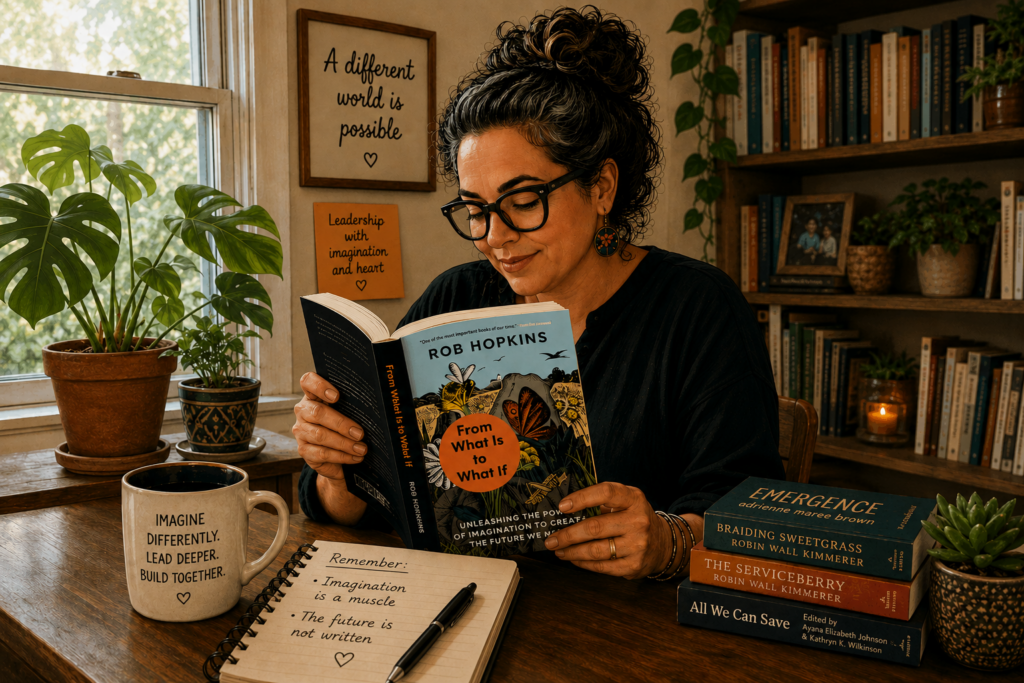
I think that is part of what Rob Hopkins is trying to interrupt in From What Is to What If, which Cris and I have been reading chapter by chapter with our book circle. Hopkins’s argument is not simply that imagination is useful, but that imagination is necessary for collective survival, especially in periods of profound disruption and uncertainty.
That lands for me because I think many leaders have quietly lost access to their imaginative capacity without even realizing it. The issue is not lack of intelligence or creativity, but rather that constant urgency narrows the field of vision.
When people are overwhelmed, anxious, over-scheduled, under-resourced, and perpetually reacting, they become more concrete in their thinking. They focus on managing immediate demands. They optimize existing systems. They try to survive the week.
That’s understandable, but survival mode is not the same thing as leadership.
Leadership requires the ability to hold reality honestly while still remaining open to possibility. That tension is important. Too much “visionary thinking” becomes detached from material conditions and slides into performance, fantasy, or motivational branding. I have very little patience for that kind of leadership language, especially right now.
At the same time, purely reactive leadership creates its own kind of danger. If leaders can only respond to what already exists, then the future gets shaped almost entirely by momentum, habit, and whoever already holds the most power.
Imagination disrupts that inevitability.
Contrary to how many people talk about it, imagination is not mystical or magical or otherworldly. It is cognitive, emotional, relational, and deeply embodied.
Our brains are constantly running simulations. We rehearse conversations before we have them. We anticipate outcomes. We revisit old interactions and imagine alternate responses. We envision disaster scenarios and picture better ones. We mentally inhabit possible futures all the time.
The question is not whether human beings imagine, but whether we do it consciously, expansively, and courageously enough to loosen the grip of the invisible boxes we live inside.
I keep thinking about how often leaders say they want innovation while structurally eliminating every condition that makes imagination possible, so that there is little spaciousness, reflection, or genuine dialogue, as well as decreased experimentation, tolerance for uncertainty, and psychological safety around imperfect ideas. The result is (not surprisingly) relentless production and urgency. No wonder people stop thinking creatively.
Imagination requires oxygen, enough breathing room for people to think beyond immediate performance demands. And imagination also requires contact with perspectives beyond our own.
One of the things Hopkins argues throughout the book is that imagination expands through exposure: to different communities, different possibilities, different ways of organizing life. That feels deeply true to me.
People’s sense of what is “realistic” is often shaped by what they have personally seen modeled around them. If nobody in your world rests, rest feels irresponsible. If nobody shares power, shared leadership feels naïve. If nobody sets boundaries, boundaries feel selfish. If nobody imagines differently, the current arrangement of things starts to feel permanent.
That is why imagination is not merely personal. It is social. We borrow possibility from each other.
One of the risks in coaching is assuming that every client is primarily trapped by their thinking. Sometimes clients are responding quite accurately to conditions that are genuinely constraining: Economic realities, caregiving responsibilities, organizational politics, discrimination, chronic illness, exhaustion that is not hypothetical or symbolic, but physiological and cumulative.
What imagination can sometimes offer these clients is something quieter and more humane. A little more space between the person and the inevitability of the story they have been handed. A chance to reconsider which constraints are truly fixed and which have simply become normalized through repetition, fear, culture, or exhaustion. A chance to notice possibilities that were previously invisible because survival mode narrows perception so dramatically
I think that is part of why burnout can feel so spiritually flattening. Over time, people stop imagining altogether. The future becomes nothing more than an extension of the present. The goal shifts from meaning or contribution or creativity to simply getting through the week with the least possible damage.
When that happens, even very capable people can begin to experience the world as strangely inevitable. To believe this is just how things are, what leadership requires, what adulthood feels like, what happens to everyone eventually.
Sometimes those statements may be partially true: Some realities are painful and enduring and cannot be solved through reframing exercises or inspirational language. But I also think human beings need some relationship to possibility in order to remain psychologically and socially alive. That sense that the future is not entirely closed, that different choices, structures, relationships, practices, or ways of being might still be available, even if only incrementally at first.
Without imagination, we become trapped inside inherited futures. Most of us keep reproducing systems and ways of living that many people already know are harmful because we cannot collectively (or individually) picture what else might exist.
And that, to me, is one of the deepest leadership challenges of this moment: Helping ourselves and each other recover the capacity to imagine (individually and communally) what else could be possible together.