
- Leadership That Feels Like You
- Because we are all leaders—and it’s time to lead your way, with joyful purpose.

What Rob Hopkins’s From What Is to What If taught me about getting a client off the page and into the experience.
In 2010, a man named Jason Roberts looked at a dead block in Dallas: a stretch of boarded-up buildings and fast traffic, with nowhere safe to walk or ride. The city’s own rules guaranteed it would stay that way. Just being allowed to plant a few flowers, he found, would run a thousand dollars in permits. So one weekend he gathered a group of friends and neighbors and broke every bylaw on the books. They brought in café seating and historic lights, painted cycle paths on the street, set out flowers, and taped the broken rules to the windows so anyone walking by could see exactly what they were doing. Then they invited the city staff and council members to come have a look. The officials walked the block, saw what it could be, and went back and started changing the rules. Roberts calls this work “guerrilla bottom-up place-making.”
Reading this in Rob Hopkins’s From What Is to What If, what stays with me is the strategy underneath the rule-breaking. Roberts skipped the proposal. He built a small, real, temporary version of a better block and let people stand inside it, and the experience made a case that no argument could have. I’ve been turning that over as a coach, because it names something about how the people I work with actually get unstuck.
Picture a client weighing a real change: the stable job she’s outgrown set against work that would mean more and pay in uncertainty. Where does that decision usually live? On paper. Pros and cons, scenarios, a spreadsheet of outcomes, the worst case rehearsed in vivid detail at two in the morning. We treat that deliberation as careful and responsible, and sometimes it is. It also keeps the future entirely abstract, and an abstract future is the one place where fear gets to write the whole script unchallenged.
The futurist Stuart Candy has a phrase for the antidote: giving people “visceral tastes of the future,” experiences of a possible life instead of descriptions of one. The coaching move I took from the Dallas block is a small-scale version of that. So instead of coaching a client toward a decision about an imagined future, I help her run a contained, real piece of it over a weekend. Then we coach what the experience told her.
Here’s how that goes, in a composite I’ll keep deliberately illustrative. Carmen is a senior operations manager, well paid and well regarded, and quietly done with it. For a year she’d been picturing something vaguer and warmer: convening people, hosting the kind of conversations that don’t happen at work, being someone who makes a room feel safe enough for honesty. Every time we approached it head-on, she retreated to the spreadsheet. Could it pay? Was it a real calling or a midlife indulgence? The questions were reasonable, and they went nowhere, because not one of them could be answered in the abstract.
So we designed a weekend around one small thing: a single gathering. She’d invite eight people to her home on a Saturday afternoon, choose a question she genuinely cared about, and host a two-hour conversation around it. That was the entire assignment. Plan it, run it, and pay attention to what happened in her own body while she did.
She came back changed in a way the spreadsheet had never managed. Two things surprised her. The part she’d dreaded, being visibly in charge of a room, turned out to be easy and even pleasurable; she’d been carrying an old story about not wanting to impose, and two hours of actual hosting contradicted it on the spot. And the part she’d assumed she wanted, having the smart answers, felt strangely hollow when it arrived. What lit her up was a moment when two guests who’d never met found something real between them, and all she’d done was make the space for it. That was the real discovery. She’d cast herself as the expert in the daydream; the role she actually wanted was the host.
That distinction is the coaching. A pro/con list was never going to surface it, because she didn’t know it was true until a Saturday afternoon told her. Our next several sessions finally had something concrete to work with.
The question shifted from the unanswerable one (“should I leave my job?”) to a workable one: what would a life organized around hosting actually ask of her, and what’s the smallest real version of it she could build next?
If you want to run this with your own clients, a few things made Carmen’s weekend work, and they’re worth naming so you can design your own.
There’s a reason the low stakes matter beyond logistics. A person who feels genuinely threatened narrows; her attention contracts to whatever danger is in front of her, and the wide-open, playful state that imagining a different life requires simply isn’t available to her. (Hopkins makes a more neurological version of this argument. The behavioral version is plenty for our purposes, and it’s the one you can actually watch happen in the room.) Keep the test-drive small and safe, and your client’s imagination stays online for the work.
The gathering is one version. The same move adapts.
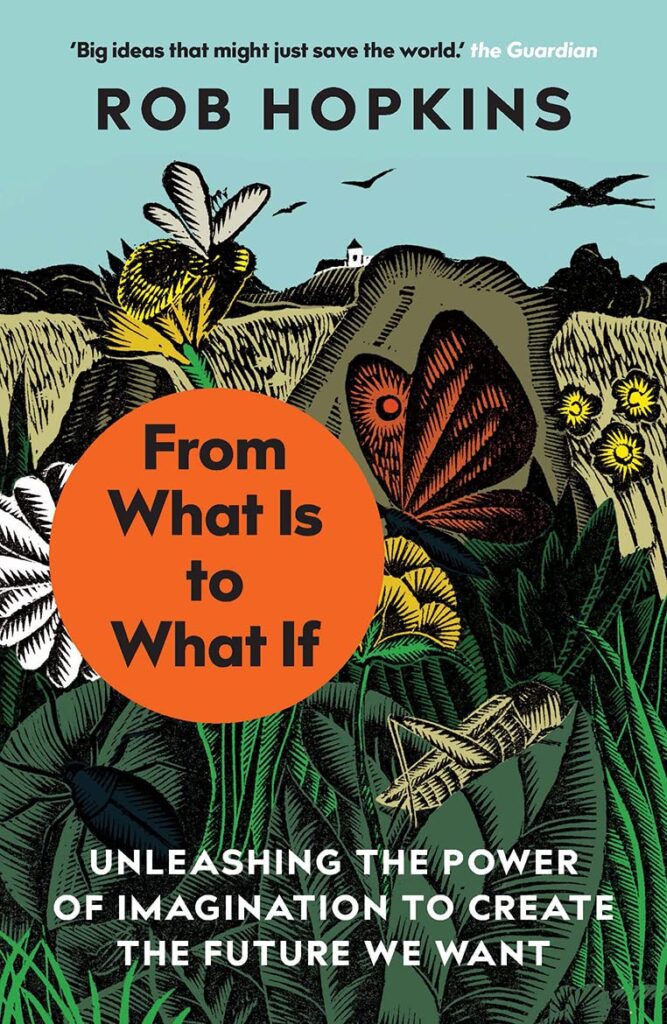
I took this one as an audiobook, the way most books reach me now: nested on the sofa with the AC going and something warm to drink. More often than not I have the print copy open at the same time, underlining and scribbling in the margins while Hopkins talks, because seeing the words and marking them up is how my brain catches connections it would otherwise let slide past. He narrates it himself, and he reads like someone thinking out loud in good company. The test-drive is one spark among a great many; the book is full of people who built small, real versions of a different world and let the experience do the persuading. As far as I can find, it’s available in English only; I haven’t come across a Spanish translation. If you coach people through change, it’s worth the hours in either form, on the page or in your ears.
The deeper I get into this work, the more I trust experience over deliberation when a client is genuinely stuck. A person can weigh a possible life for a year and still not know whether it fits her; a single real weekend inside it will tell her something the weighing never could.
If this is the kind of coaching you want more of, practical moves drawn from good thinking and tested against what actually happens in the room, that’s what Cris and I write about in the newsletter, and we’d love to have you there.