
- Leadership That Feels Like You
- Because we are all leaders—and it’s time to lead your way, with joyful purpose.
There was a period of time, beginning around the 2015 election cycle in the United States and intensifying through the pandemic and the 2024 election, when I realized something important:
Many thoughtful, ethical, deeply caring people were becoming psychologically overwhelmed by the political climate rather than energized by democratic participation.
The news cycle became relentless. Social media amplified outrage, catastrophe, division, and fear. Every notification felt urgent. Every headline felt existential. Many people started living in a constant state of emotional activation.
I know because I lived it too.
After the 2015 election, my body reacted before my mind fully understood what was happening. My face broke out in angry red splotches that lasted for months. Every time my phone vibrated with a notification, my heart raced. I lived in a state of permanent outrage and disbelief. I could not believe what half the country had done. And somewhere underneath all of that, I also knew something else:
This was unsustainable.
Over time, slowly and intentionally, I started changing my relationship to the outrage economy. I turned off notifications. I resisted rage bait. I retrained my algorithms instead of letting them train me. I leaned more deeply into meaningful work, especially my work educating immigrant children living in poverty. I committed to transformational coaching training. I started meditating for three minutes, then five. Eventually I discovered loving-kindness meditation, not as a performance of moral superiority, but as a way to stop drowning in hatred and begin returning to curiosity.
That process changed me. The world didn’t become safer or easier, but I stopped allowing constant fear and outrage to completely colonize my nervous system.
And increasingly, I began noticing that many of the people I coached, taught, and worked alongside were struggling with the same thing: Exhaustion.
One of the most dangerous misunderstandings in our current political culture is the idea that cynicism is evidence of intelligence.
It is not.
Cynicism shuts down our imagination. We lose the ability to envision different, which slowly erodes our ability to feel differently too. Over time, people become emotionally and relationally stuck without fully realizing it.
And cynicism is contagious.
Joy starts feeling naïve. Hope starts feeling embarrassing. Playfulness feels irresponsible. Curiosity feels weak. Belonging feels impossible. The emotional range of human life begins narrowing into outrage, fear, sarcasm, helplessness, and despair.
It becomes a kind of black hole pulling everything into its void.
As coaches, we need to understand this dynamic deeply because many politically exhausted clients are not simply “stressed.” They are psychologically saturated. Their nervous systems are flooded. They are trying to metabolize a nonstop stream of threat, uncertainty, polarization, grief, and helplessness while still functioning in their daily lives.
And many of them feel profoundly alone inside that experience.
I hear versions of it constantly: “It just sucks.” “It feels relentless.” “Everything feels life and death all the time.” “There’s no peace anymore.” “We’re all going to die.”
These are not merely political opinions. They are expressions of overwhelm.
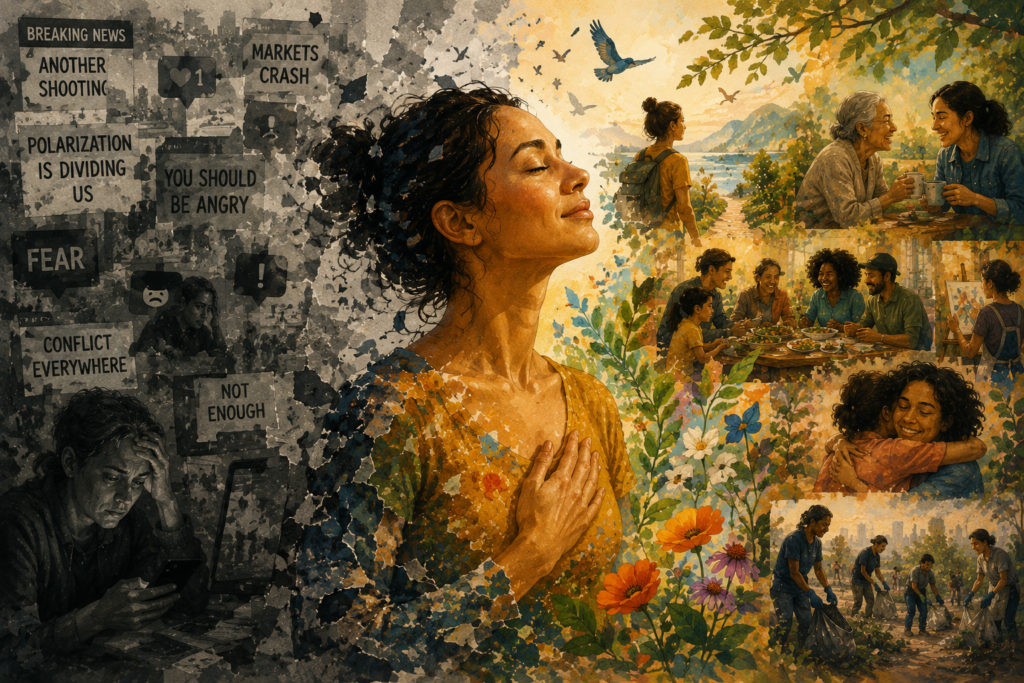
When we talk about joyful democracy, we are not talking about denial, forced positivity, or pretending everything is okay.
Things are not okay in many parts of the world right now. Naming that reality matters.
In fact, I think noticing and labeling what is happening is often the first step toward grounded engagement. Not bypassing. Not numbing. Not pretending.
Awareness matters.
But awareness without restoration eventually becomes paralysis.
Joyful democracy is the practice of remaining connected to humanity, imagination, agency, and belonging even in the midst of conflict, uncertainty, and change.
It is not optimism.
It is active hope.
Active hope looks playful instead of brittle. Intentional instead of reactive. Bridging instead of collapsing. Steady instead of hyperventilating. Restorative instead of extractive.
It is rooted in the belief that:
Most importantly, active hope preserves our capacity for agency.
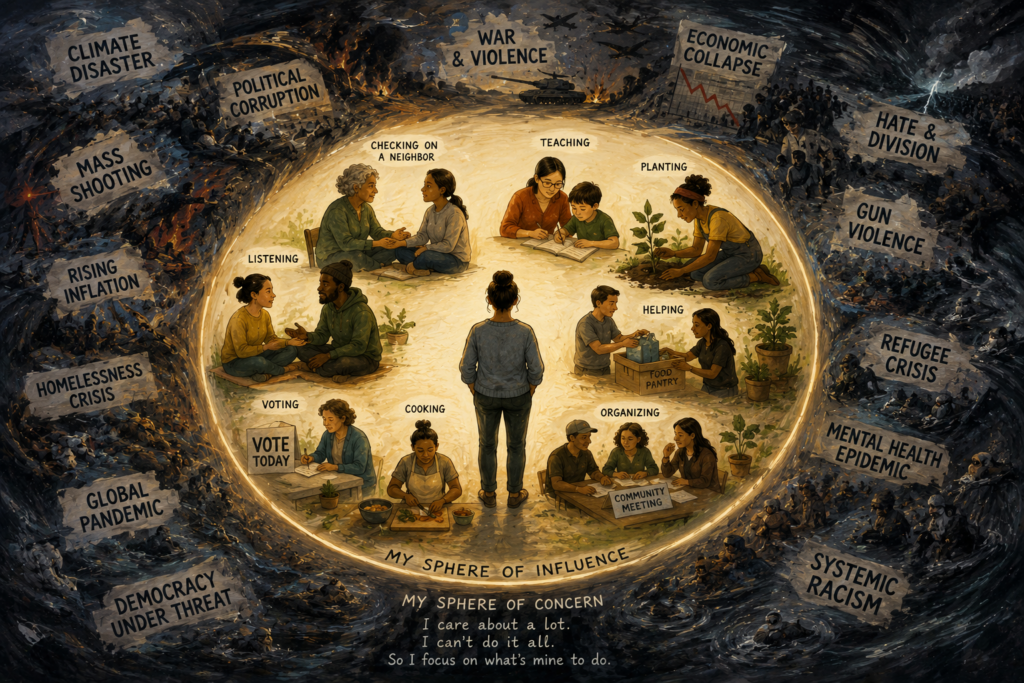
When people reconnect to grounded joy, they often become steadier. More spacious. More capable of discernment. They begin recognizing the difference between their sphere of concern and their sphere of influence.
And something important happens: They stop giving away so much of their psychological power to systems, institutions, media environments, and political actors that thrive on fear and helplessness.
They become happier, yes. And they also become more capable of meaningful action.
We coaches sometimes frame political exhaustion as an individual wellness issue.
I think that is a mistake.
When we over-individualize these experiences, we can accidentally reinforce the very isolation that keeps people trapped in fear and helplessness.
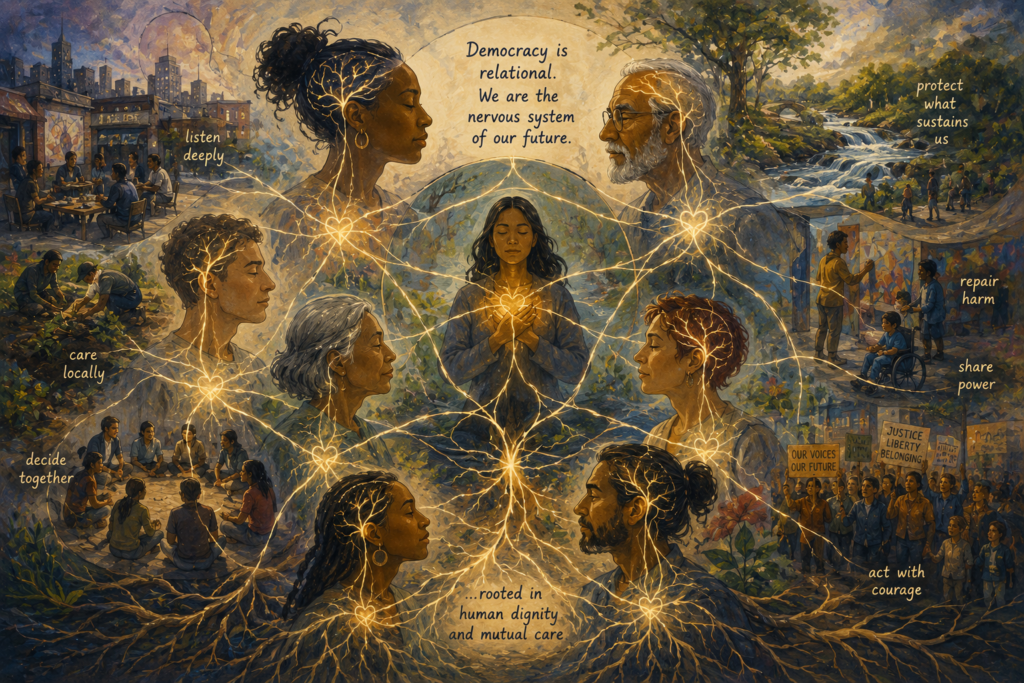
The truth is: human beings are relational.
Together we regulate, grieve, imagine, heal, and become braver.
One of the most important things coaches can offer politically exhausted clients is not simply emotional regulation, but reconnection. Connection breaks through the artificial boundaries created by fear and overwhelm. It reminds people they are not carrying reality alone.
And that matters because agency is deeply relational. Together, we are indeed braver, stronger, more creative, and more capable than we often realize in isolation.
One practice I often recommend is what I think of as a Democratic Energy Audit.
Invite clients to explore questions like:
This exercise often helps clients recognize that they do not need to choose between total disengagement and constant emotional immersion. Civic engagement is not a binary; it’s a spectrum.
Joyful democracy does not only live in elections, institutions, movements, or big actions. It lives in ordinary moments too.
It looks like:
And perhaps most importantly, it looks like what Mr. Rogers taught generations of children:
Look for the helpers.
Look for the people quietly creating repair, dignity, care, courage, beauty, and connection.
In your neighborhood.
In your school.
In your community.
Nationally.
Globally.
Notice how they are doing it.
If they can do it, so can we.
I believe coaches have an important role to play in this historical moment. While we don’t possess special answers or magic wands, coaches do create space for reflection, discernment, emotional honesty, imagination, and reconnection. In a culture designed to keep people reactive and overwhelmed, those capacities matter profoundly.
Often the most radical thing we can help clients recover is humanity: The ability to breathe, imagine, connect. To notice beauty. To stay curious and remain capable of love.
To act intentionally instead of reactively.
Democratic life depends on those capacities more than we realize.
And underneath all of this is one truth I hope every coach remembers:
You are not alone.
Neither is your client or your neighbor. Neither is the stranger carrying grief quietly through the grocery store.
We belong by virtue of being.
And by the way, so do the trees, the birds, the sea, and the air.
Joyful democracy begins there.