
- Leadership That Feels Like You
- Because we are all leaders—and it’s time to lead your way, with joyful purpose.

A reflection, after a book-circle discussion of Rob Hopkins’s From What Is to What If.
During a recent book-circle discussion of Chapter 5 of From What Is to What If, I found myself unexpectedly restless. Much of it resonated. Hopkins critiques modern education for narrowing imagination through over-standardization, relentless testing, the fear of failure, and rigid institutional structures. After more than twenty years inside schools, as a teacher and later as a college instructor and administrator, none of that struck me as controversial. If anything, it felt familiar.
What stayed with me afterward was an absence. The chapter attends closely to the children, and barely at all to the adults standing in the room with them. Teachers appear mostly as the people shaping students, with little attention to the conditions shaping the teachers themselves. That gap is what I kept circling.
Here is the part the chapter doesn’t show.
I watched schools absorb wave after wave of change: new mandates, evaluation systems, curricula, testing regimes, accountability frameworks.
The cycle had a rhythm I came to know. A framework would arrive in August, introduced over two days of in-service before anyone had taught a single child with it. Binders went on the shelf. By the time a teacher had begun to make the thing her own, to feel where it worked and where it didn’t, the next framework was already announced, and the new binder joined the others, spines uncracked.
There was always another training, another rollout, another set of metrics, another expectation. Rarely was there time for any of it to mature, or for reflection to happen at all.
The work outgrew the hours allotted to it, and the system quietly normalized that. The overflow went home with people, into their evenings and weekends, and the corners of their personal lives. Many carried it because they cared about their students and about doing the work well.
It’s impossible to pull these dynamics apart from gender.
Teaching, especially in the early grades, remains an overwhelmingly female profession, and a great deal of the system runs quietly on labor that women have long been expected to absorb without much notice:
Teachers aren’t only expected to teach. They’re expected to comfort, anticipate, soothe, document, organize, and hold relational continuity for students and families, much of it outside contractual hours and outside any system that names it as skilled work, because it gets treated as an extension of being a woman rather than as labor.
Then many go home to a second shift of it: childcare, eldercare, the running of a house, the emotional weather of a family.
None of this is in the chapter. Hopkins notices women’s lives elsewhere in the book, but his argument about schools never connects to the gendered labor the schools run on.
Under those conditions, exhaustion is the predictable outcome of a system that normalizes chronic overflow. It says nothing about anyone’s resilience or boundaries.
At some point I started asking what happens to people when institutions consistently ask for more than they can sustainably give, not only physically but cognitively and emotionally. My sense is that imagination narrows under chronic overload. Curiosity narrows with it, and so does the ability to imagine that things could be otherwise.
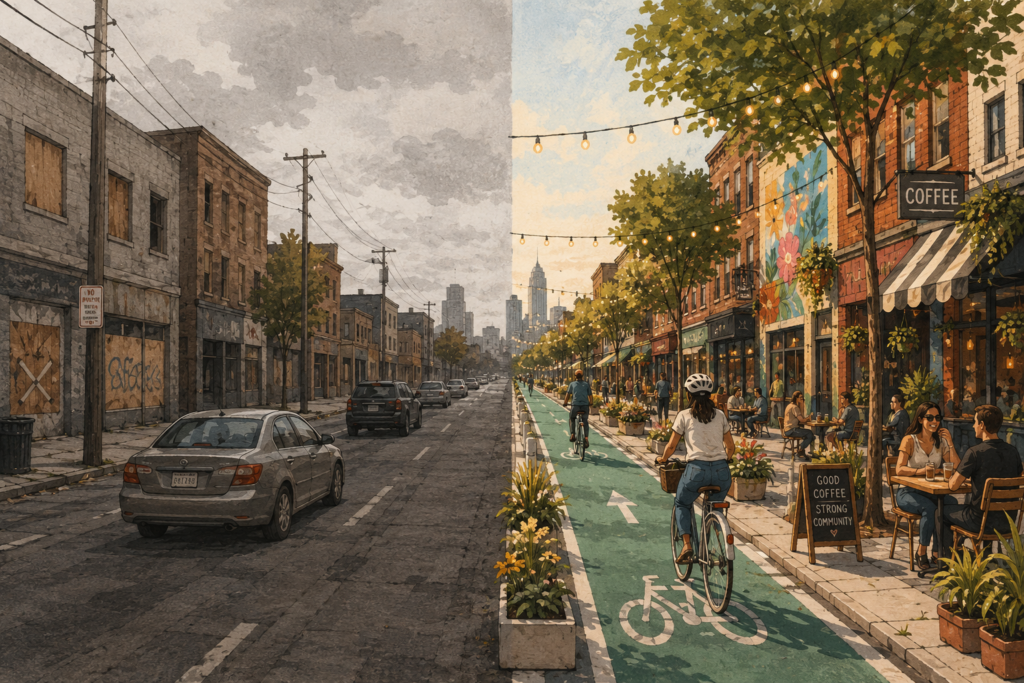
From “what is” to “what if”
Institutions say they want innovation and transformation. Many then dismantle the very conditions that make those things possible:
In education the contradiction is especially easy to see.
We ask teachers to nurture curiosity while scripting their lessons line by line, and students to become engaged learners inside systems that measure their growth against a bar that keeps moving. We celebrate innovation in places where a single mistake can carry real professional cost.
None of this makes schools uniquely broken. Education just makes visible a tension that runs through many institutions.
I see the same pattern well beyond schools: people asked to collaborate while overloaded, to adapt while exhausted, to stay creative under constant evaluation, to be human-centered inside systems that leave little room for actual humanity.
This is part of why I think coaching matters.
Coaching doesn’t transform systems, and individual mindset work doesn’t dissolve structural problems. I want to be honest about that.
Its power is smaller and real: for a little while, it can hold open a space where imagination becomes possible again. A space where a person isn’t being graded or optimized or hurried toward a prescribed answer, and where uncertainty can be explored instead of closed off too fast.
Given a little of that, people start to reconnect with the parts of themselves that got compressed under constant performance pressure.
Those moments matter more than we tend to think. They give people back a sense of agency, or of possibility, that had quietly narrowed over the years.
Looking back, the adults who stayed most psychologically alive inside hard systems were often the ones who found ways to keep some humanity inside the machinery. They weren’t necessarily the most productive people, or the most outwardly successful.
What they did was ordinary.
None of this fixed the institutions. It let people stay present and connected to one another inside places built to flatten both.
What I think about now is what people actually need in order to stay imaginative and psychologically alive inside an institution over a long stretch of years. Real people, the tired and responsible kind, carrying workloads and grief and caregiving and the ordinary weight of being alive.
I don’t have a sweeping blueprint for a transformed school system. If anything, the conversation surfaced how hard large-scale transformation is to picture in concrete terms after decades inside institutions.
Experience teaches you that every structure makes tradeoffs, and that implementation is the whole of the work, the place where everything actually gets decided. It also teaches you that systems are built of people carrying competing needs and real constraints.
But I can picture conditions that would help:
That feels like a more useful conversation than whether systems ought to be more imaginative. Of course they should. The harder question is whether we’re willing to build the conditions that let the people inside those systems stay fully human while they do the work.
If reflections like this are what you come here for, you can have them in your inbox, where most of this thinking lives.